
Building the Platform That Puts Your Data Back in Your Hands
A message from Nawshad Shaikh (CEO) and Dnyaneshwar Sonawane (CTO), Co-Founders of The Salsabil Group
A Question We Could Not Ignore
Every week, a business owner somewhere discovers their AI assistant has just sent a confidential client proposal to a server farm in Virginia. A school learns that its students’ homework conversations are being used to train a commercial AI model. A construction firm finds out that its proprietary cost estimates live on someone else’s cloud infrastructure.
We found ourselves asking a simple question: why should your intelligence — your knowledge, your documents, your clients’ data — be the raw material for someone else’s business?
The answer, we decided, is that it should not. And so we built TSiP.
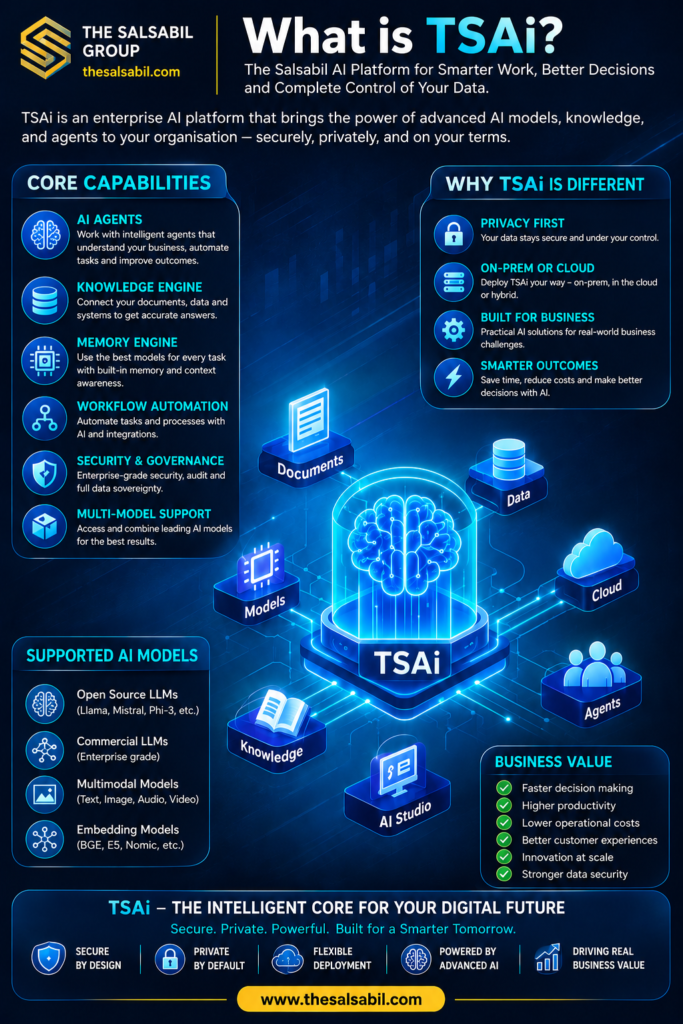
What TSAi is, at a glance.
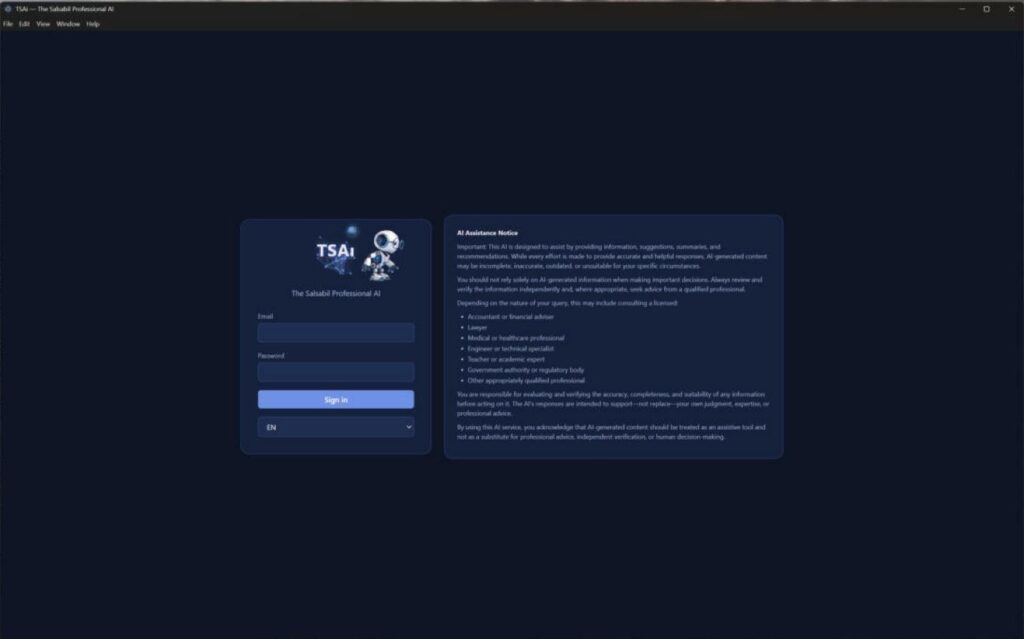
TSAi’s own login screen — branded, real, not a mockup.
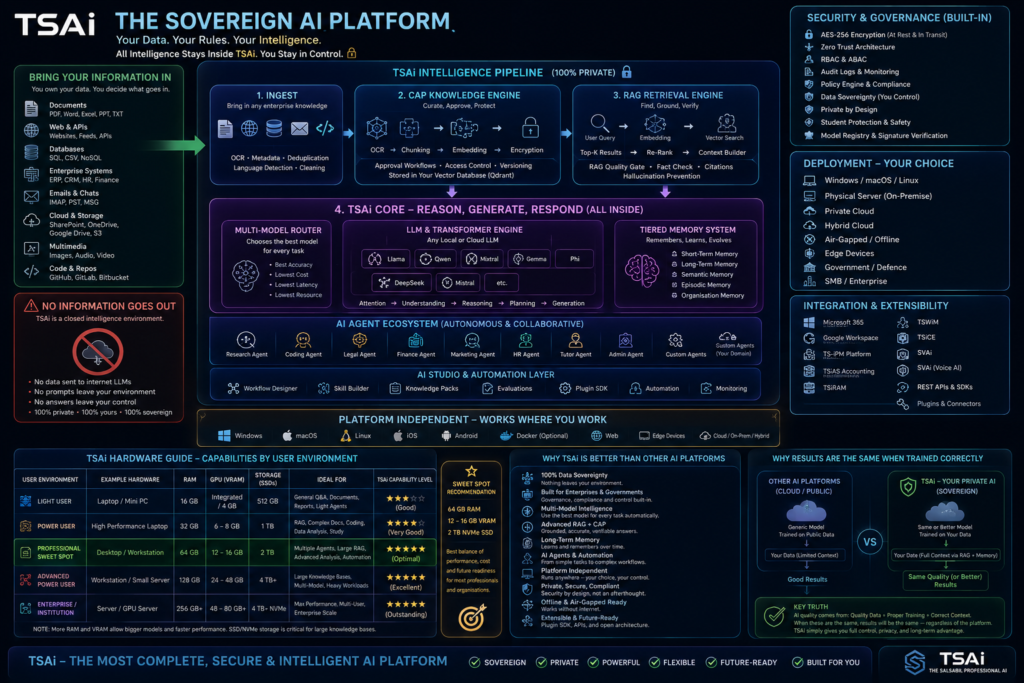
What Sovereign AI means, architecturally.
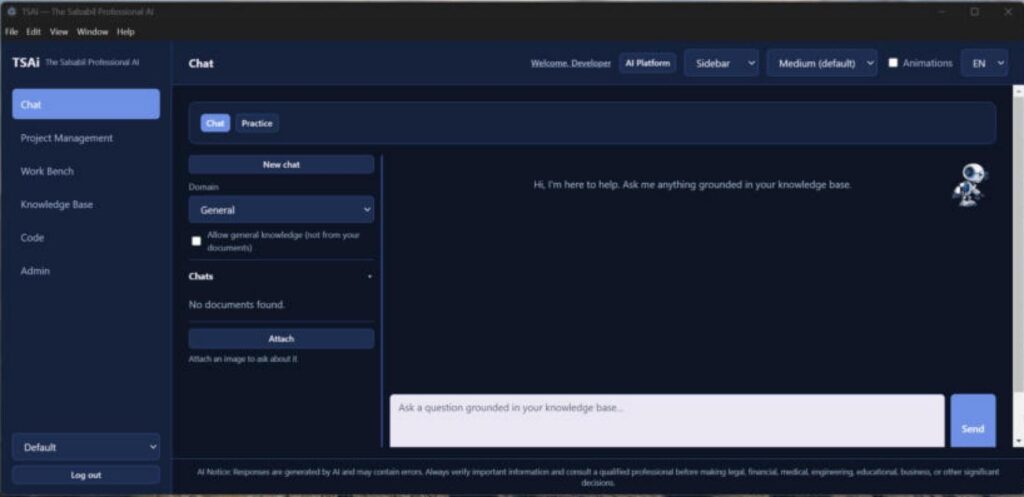
TSAi Chat — the concept, running for real on a customer’s own machine.
From the CEO — Nawshad Shaikh
“Sovereign AI is not a product feature. It is an architectural commitment. From the first line of code, we decided that no query, no document, and no conversation from our customers would ever transit through infrastructure we do not control on their behalf. That commitment has never changed.”
My background is in business development and technology strategy, with a particular focus on markets where language and data sovereignty are not optional considerations — they are commercial and regulatory requirements. Markets where mainstream AI platforms offer poor non-English language support and data-residency mandates are tightening are one such example. Australia, where small businesses are being priced out of AI productivity tools by enterprise-grade licensing, is another.
When Dnyaneshwar and I founded The Salsabil Group in 2024, we set out to build a platform that serves both of these markets from a single architecture: local-first, multilingual by design, and priced for the people enterprise software ignores.
In two years, we have built seven products. Four are at production release. One — TSAi, our AI foundation — is feature-complete and approaching general availability. None of them require a cloud account to operate. All of them run natively in English, Arabic (RTL), French, and Persian/Farsi (RTL), with Hindi, Bengali, and Urdu in active development.
We are based in Canberra, Australia, but our ambition is global — architected from day one for markets where mainstream AI platforms fall short: strict data-residency requirements, non-English-first language needs, and small businesses priced out of enterprise licensing.
From the CTO — Dnyaneshwar Sonawane
“The question I ask before every architectural decision is this: if Salsabil disappeared tomorrow, would a customer lose access to their data? The answer must always be no. Everything else follows from that.”
My focus is on building AI systems that are both genuinely capable and genuinely sovereign. That is a harder engineering problem than most people appreciate. It means running local inference models that adapt automatically to whatever hardware the customer owns — from a CPU-only laptop running our smallest 1.5B parameter model to an RTX 4090 workstation running a 32B model with a 32,768-token context window. It means grounding every AI response in the customer’s own approved documents before the language model is even consulted. It means designing student data protection as an architectural rule: student data is never sent to Salsabil, any third party, or any cloud AI provider, with one narrow opt-in guardian-digest exception authorised under ADR-027 and not yet built.
In the two years since we founded the company, my team has delivered:
• TSAi — a feature-complete sovereign AI platform with an AI Studio, agent builder (60-template catalogue), tutor mode, image generation, code execution sandbox, and CAD/ROS output
• TSOS — a sovereign office suite with 91 spreadsheet functions, Solver/Goal Seek, offline spell and grammar checking, and data studio BI dashboards
• TSiSS — a physical site security platform that generates compliance reports for five regulatory frameworks used across multiple international markets, in the customer’s own language
• TSiCE — a construction cost estimator with region-specific public-sector report templates, multi-currency support, and AI-generated narratives in the customer’s own language
• TSiAS, TSiRAM, and SVAi — accounting software, CRM, and voice AI, all at production release
Every product follows the same architectural principle: it runs on the customer’s hardware, it stores data in an encrypted local database, and it consumes TSAi’s intelligence through our versioned external API rather than embedding its own AI stack. One AI engine. Seven products. No cloud dependency.
TSiP — The Salsabil Intelligent Platform
TSiP is the umbrella under which all our products operate. It is not a cloud platform. It is an architecture — a set of engineering standards, security protocols, and integration patterns that ensure every Salsabil product behaves consistently, securely, and sovereignly on the customer’s own infrastructure.
The Seven Products
| Product | Status | Category | What it does |
| TSAi | Feature-complete | AI Platform | Sovereign AI: chat, studio, agents, tutor mode, code, image generation |
| TSOS | In Build | Office Suite | Sovereign office: word processor, spreadsheet, data studio, PDF |
| SVAi | Production v1.0 | Voice AI | Sovereign voice AI platform, Arabic TTS/ASR |
| TSiAS | Production v1.0.1 | Accounting | AI-grounded accounting and invoicing software |
| TSiRAM | Production v1.0 | CRM | AI-grounded customer relationship management |
| TSiSS | Production v1.0 | Security | Physical site security: access, visitor, patrol, international compliance |
| TSiCE | Pre-pilot v1.0 | Construction | Cost estimator: BOQ, industry-standard templates, multi-currency |
What Makes Us Different
There are four properties that, taken together, no competitor in any of our product categories currently offers:
• Sovereignty: your data stays on your hardware under your control, permanently
• Multilingual native: English, Arabic (RTL), French, and Persian/Farsi (RTL) ship today as first-class languages, not a translation layer — with Hindi, Bengali, and Urdu in active development
• SMB pricing: from AUD $179 one-time for TSAi, without per-query cloud compute costs or recurring subscription fees
• Adaptive hardware: runs on what you already own, from an eight-year-old laptop to a workstation GPU
We are not the biggest AI company. We are building the most trustworthy one, for the customers enterprise software forgot.
Where We Are Going
In the next twelve months, we are focused on three objectives: shipping TSAi to its first general-availability customers, establishing an international presence in our priority multilingual markets, and signing our first pilot deployments of TSiSS and TSiCE.
Our five-year vision extends to TASC Robotics — an autonomous marine systems division that will use TSAi as its onboard intelligence layer. TSAi already generates ROS robot description files today. The foundation is built.
“We are building the platform that puts intelligence back in your hands — not in ours, not in a cloud provider’s, but yours. That is the Salsabil commitment, and it is the only one that matters.” — Nawshad Shaikh & Dnyaneshwar Sonawane
Risk, Ownership & Real Value
Risk: TSiP vs the Cloud AI Market
Every mainstream AI platform on the market today — enterprise chat assistants, cloud AI suites, per-seat AI add-ons — is a rented service. The moment a customer stops paying, access stops, and years of configuration, integrations, and institutional knowledge go with it. Pricing rises on the vendor’s schedule, not the customer’s. Data uploaded to those platforms sits on infrastructure the customer doesn’t control.
TSiP is built to remove each of these risks structurally, not contractually:
• No vendor kill-switch. TSAi and every TSiP product run on hardware the customer owns. There is no remote disable and no dependency on Salsabil’s servers for day-to-day operation.
• No recurring exposure to price rises. The customer pays once for the product. There is no annual renewal that can be repriced upward, and no usage-based billing surprises.
• No default third-party data exposure. Processing happens on the customer’s own hardware, so there is no external server in the pipeline where a breach, subpoena, or policy change could expose customer data.
Ownership: You Own What You Bought
When a customer buys TSAi or any TSiP product, they own that installation outright from the moment of purchase. This is not a subscription to ongoing access — it is a one-time purchase of software that belongs to them, to run for as long as they choose, on hardware they control. There is no recurring fee required to keep it working.
Upgrades, Not Renewals
As TSAi and the wider TSiP line evolve, customers can choose to purchase an upgrade for new capabilities — but they are never required to. An upgrade costs meaningfully less than buying the product again from scratch, because the customer is paying only for what’s new, not repurchasing what they already own.
TSOS — Free, No Strings Attached
TSOS, the Salsabil Office Suite — word processor, spreadsheet, Data Studio BI, and PDF editor — is free for everyone, whether or not they’ve purchased TSAi. No trial period, no feature gate, no upsell requirement.
Value to the End User
Owning the software outright, rather than renting continued access to it, changes the economics and the risk profile at the same time. The customer’s cost is fixed and known upfront. Their data stays under their own control by architecture, not by policy. And their tools keep working regardless of what happens to any vendor’s business, pricing strategy, or roadmap decisions.
Why Choose TSiP Over What’s Already on the Market
Mainstream AI platforms are priced and structured around continuous payment for continuous access — stop paying, lose the tool. TSiP inverts that relationship: pay once, own it, and choose only if and when to upgrade. For a small business or individual professional, that is the difference between a tool that compounds in value over time and one that represents an ongoing, ever-rising cost of doing business.
The Everyday Problems It Solves
• Subscription fatigue — no stack of a dozen SaaS bills that quietly rise every renewal.
• The “vendor could cut us off” problem — no cloud dependency means a billing dispute, price hike, or vendor shutdown can’t take away access to a tool the business already paid for.
• The privacy and compliance anxiety problem — sensitive documents, client files, and financial or student records never have to leave the building to get AI assistance.
• The “the AI stopped working when the internet dropped” problem — TSAi and the wider TSiP suite run fully offline.
• The cost-of-growth problem — no per-seat licensing that penalises a growing team.
The Cost-Benefit, in Real Numbers
A single professional seat on a mainstream cloud AI platform typically runs in the order of AUD $30 per user per month — around $360 a year, per person, before any price increase. Over three years, that is roughly $1,080 for one seat, with no end date and no ownership at the end of it.
TSAi’s Individual tier is a one-time purchase of AUD $249. There is no second payment required to keep using it — ever. A five-person team on TSAi’s Small Team tier pays AUD $649 once, compared with a mainstream cloud AI subscription for the same team running to roughly $1,800 a year and rising. The one-time model pays for itself well within the first year, and every year after that is free.